Welcome LTMC CNC Busbar Machine
Language:
 ∷
 ∷
 ∷

∷
∷
∷
 ∷
∷
∷
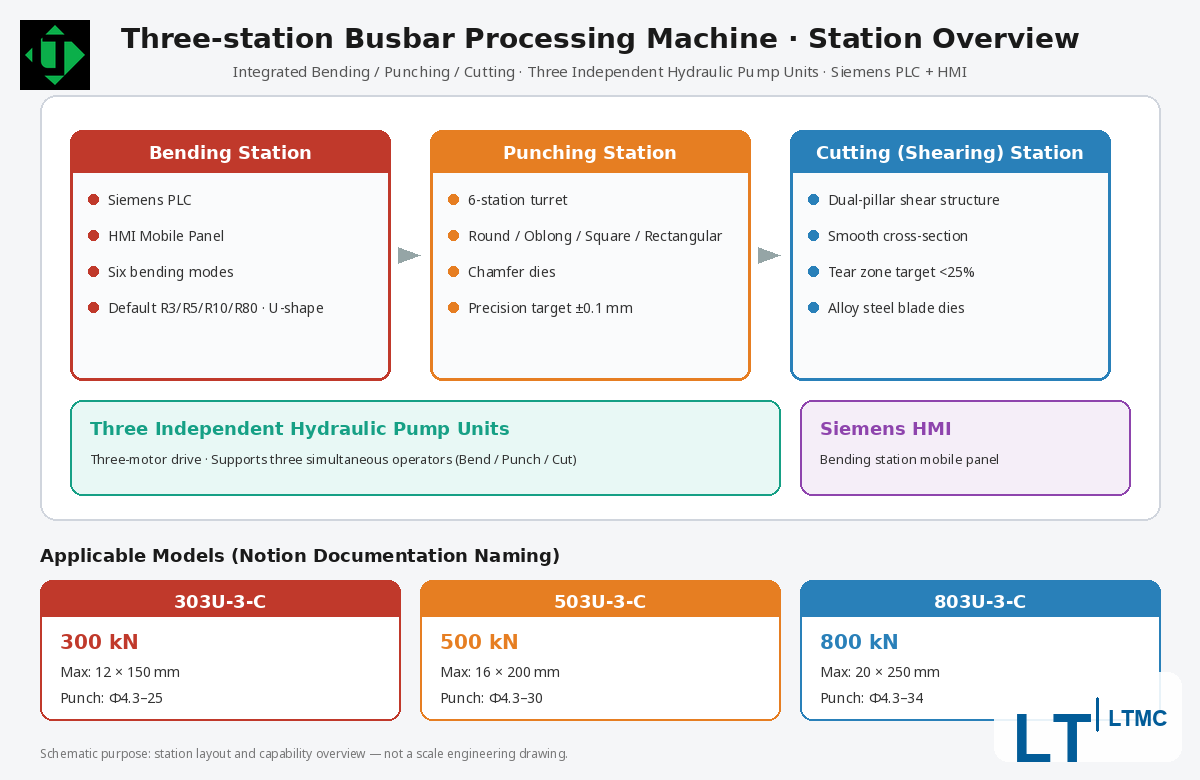
A three-station busbar machine (3-in-1 busbar processing machine) integrates punching, cutting and bending in one frame, so copper or aluminum busbars for switchgear, transformers and power distribution are fabricated without transferring bars between three separate tools. On LTMC models 303U-3-C, 503U-3-C and 803U-3-C, three hydraulic pump groups can run in parallel or in sequence. Size the machine by your largest width × thickness, hardest hole family and hardest bend family — not by a generic “best machine” claim.
| Entity | 303U-3-C | 503U-3-C | 803U-3-C |
|---|---|---|---|
| Nominal force (kN) | 300 | 500 | 800 |
| Punching diameter (mm) | Φ4.3–Φ25 | Φ4.3–Φ30 | Φ4.3–Φ34 |
| Max thickness / width (mm) | 12 / 150 | 16 / 200 | 20 / 250 |
| Max horizontal bend (mm) | 150 / 12 | 200 / 16 | 250 / 20 |
| Max vertical bend size (mm) | 10×100 | 12×120 | 12×120 |
| Motor power | 3×4 kW | 3×5.5 kW | 3×5.5 kW |
| Bend precision / repeat | ±1° / ±0.5° | ±1° / ±0.5° | ±1° / ±0.5° |
Quick selection: 303 ≈ 12×150 mm / Φ25 class; 503 ≈ 16×200 / Φ30; 803 ≈ 20×250 / Φ34. Punch diameters run Φ4.3–Φ25 / Φ30 / Φ34 respectively, and published bend accuracy is about ±1° with ±0.5° repeatability on all three frames.
List the hardest repeating part in your shop: maximum width × thickness, the tightest hole set (round and oblong), and the hardest bend set including any edge (vertical) bend. Map that part to the table above, then confirm three things before ordering: the die package, the factory voltage and frequency (standard 380 V / 50 Hz; 400 V 60 Hz, 415 V 50 Hz or 220 V 60 Hz on request), and a copper-versus-aluminum springback plan. Because bending is the most temperature- and material-sensitive station, ask for first-article samples of your own drawings during FAT.
Each station has its own motor–pump group, so punch, cut and bend can run simultaneously with three operators or sequentially with one. For mixed panel-shop work this usually beats buying a dedicated punch–shear line plus a bend center, which only pays off at high volume. See our three-in-one busbar machines for the full range.
A 3-in-1 machine that performs punching, cutting/shearing and bending of copper or aluminum busbars in a single frame — see the 303U-3-C / 503U-3-C / 803U-3-C series above.
Yes — three independent hydraulic units allow parallel work when three operators are assigned; throughput still depends on loading and fixturing.
Map your hardest bar, hole and bend to 303U-3-C (12×150), 503U-3-C (16×200) or 803U-3-C (20×250), then confirm the exact envelope on the quotation.
Contacts:Leanne
Mobile:+86 13853146766
Phone:Whatsapp:+86 13853146766
Email:[email protected]
Address: No.9566 Jingshi Rd., Jinan City, Shandong, China